Browserbase Changelog
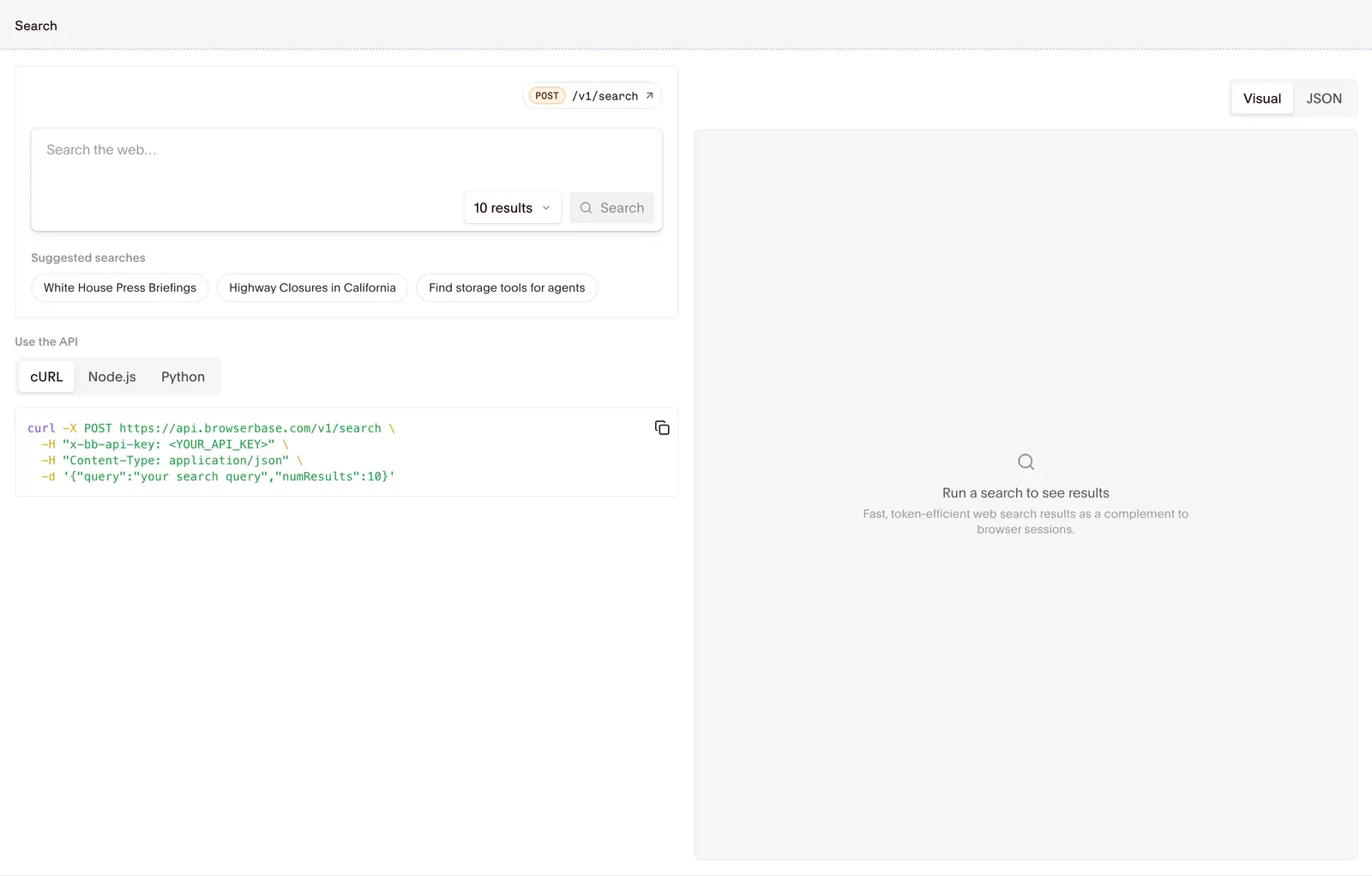
Follow us on for the latest updates.Most web agents need to be able to search the web before performing actions on a website. Browserbase Search, powered by Exa, now handles searching with a single API call.
Send a plain-text query and get back the URLs your agent needs to act on next.
import { Browserbase } from "@browserbasehq/sdk"; const bb = new Browserbase({ apiKey: process.env.BROWSERBASE_API_KEY! }); const searchResponse = await bb.search.({ query: "browserbase documentation", numResults: 10, });
Results return a url, title, and description, up to 25 results.
Each plan includes 1,000 free searches.
We love improving our Free plan.
Free users can now use up to 3 browsers concurrently (previously this was limited to 1).
Happy building!
We migrated the hosted version (SHTTP) of the Browserbase MCP server onto Browserbase-managed infrastructure to improve reliability and make ongoing updates easier.
If you are using MCP in Cursor, Claude Desktop, or another MCP client, no action is required. Keep following our setup guide to connect
Copy linkWhat changed
- MCP is now served from Browserbase-managed endpoints.
- Improved stability for longer-running MCP sessions.
Introducing, the Fetch API for Browserbase. Give us a URL and we return the page content with no browser session required. It’s fast, cheap, (~$1 / 1k pages), and perfect for agents that just need to read the web.
Get started today: docs.browserbase.com/features/fetch
const res = await bb.fetchAPI.create({ url: "https://browserbase.com/", });
Stagehand now caches the results of repeated actions, eliminating redundant LLM calls automatically, no code changes required.
When Stagehand encounters a page structure it's seen before, it serves the cached result instantly, no LLM call needed. DOM hashing validates each match, so accuracy stays high even as cache usage scales.
The result: up to 2x faster execution and ~30% cost reduction on repeat workflows. Your agents get more efficient the more they run.
Caching is conservative by default and scoped to your project. It kicks in automatically for all Stagehand users on Browserbase.

Browserbase is now a one-click integration on the Vercel Agent Marketplace. Your agents get production-grade browsers without running browsers themselves.
Agents deployed on Vercel Sandbox can connect to remote browsers over CDP, keeping your agent logic on Vercel while the browser runs on infrastructure built for automation. One API key, unified billing, no proxies or complex configuration. The integration also works alongside Vercel's AI Gateway and Sandbox out of the box.
We're also launching Web Bot Auth support with Vercel. Browserbase agents now send cryptographically signed requests that Vercel verifies, so your agents can reliably browse Vercel-hosted deployments without getting blocked by security layers.

Functions let you deploy agents and automations directly to Browserbase and run it next to the browser session it controls. You define, deploy, and invoke a function, and Browserbase handles execution, browser lifecycle, and results as one system.
What this means:
-
Lower latency, up to 70% faster
-
Fewer moving parts and less infrastructure to manage
-
Async and long-running executions with results tied directly to real browser sessions.
-
Local development mirrors production using real Browserbase sessions.
Available now in TypeScript (documentation)
npx @browserbasehq/sdk-functions init
We’ve completely rebuilt session recordings from the ground up.
Instead of DOM-based replay, Browserbase now records what the browser actually renders using a CDP-based screencast. This makes replays deterministic, accurate, and trustworthy.
What’s new:
- Pixel-accurate screen recordings (no DOM reconstruction)
- Event-driven frame capture (records only when the screen changes)
- Asynchronous, constant-time video encoding using HLS
- Seamless multi-tab playback with a shared global timeline
- Secure, signed segment delivery with CDN enforcement
- Just-in-time encoding to keep costs low and playback fast
If you tried our old session replays and lost trust in them, this rebuild is for you.
Read more here: https://www.browserbase.com/blog/session-recordings
Python, Go, Java, Ruby, Rust...Stagehand is now available on every language! With Stagehand v3 we set course to improve Stagehand's extensibility and to make it easier to bring along the tools that you all love.
Today we're extending this across all languages. Go, Ruby, Java, Rust... and a revamped Python with v3 support.
In order to get here, we are releasing the canonical implementation of Stagehand powered by our newest and most powerful features, from which every SDK will benefit immediately.
This will allow us to move faster, ship more, and focus on what matters most - building the best AI browser automation framework together.
To learn more about this major update:
Check out the docs.
Read the blog post
Use the python Migration guide
Introducing Stagehand v3! 🤘
This marks the beginning of a new foundation for Stagehand, going closer to the metal and providing more flexibility, speed, and control over the browser. We hope this inspires you to help us shape the future of web automation
Featuring:
- A generous 20-40% speed increase across
act,extract, &observecalls - Compatibility with Playwright, Puppeteer, and Patchright
- Automatic action caching (agent, stagehand.act). Go from CUA → deterministic scripts w/o inference
- A suite of non AI primitives:
pagelocator(built in closed mode shadow root traversal, with xpaths & css selectors)frameLocatordeepLocator(crosses iframes & shadow roots)
- bun compatibility
- Simplified extract schemas
- CSS selector support (id-based support coming soon)
- Targeted extract and observe across iframes & shadow roots
- More intuitive type names (observeResult is now action, act accepts an instruction string instead of an action string, solidified ModelConfiguration)